At nc-sara.org, you’ll find comprehensive details and resources on SARA membership, benefits, and meetings, as well as on the subject of state authorization.
×
WICHE State Authorization Reciprocity Agreement
What is W-SARA?
The State Authorization Reciprocity Agreement (SARA) is a voluntary initiative designed to establish comparable standards for U.S. states and territories regulating postsecondary distance education. With its reciprocity provisions, the agreement enables institutions to gain approval from their “home state” to offer distance education in participating states without having to individually apply to each state for such approval. SARA expands postsecondary educational opportunities while ensuring meaningful consumer protections for students and reducing regulatory red-tape for institutions. SARA also provides a platform for information sharing and peer learning among member states, and promotes distance education program quality for all participants.
The agreement is coordinated by the National Council for State Authorization Reciprocity Agreements (NC-SARA), in collaboration with the four regional higher education compacts. As the compact serving the Western region, WICHE is responsible for coordinating the participation of SARA member states in the Western region through the WICHE State Authorization Reciprocity Agreement (W-SARA).
Why was SARA created?
Nationwide, the number of students who accessed postsecondary education opportunities online rose dramatically in the 2000s. As institutions created more distance education courses and programs, new considerations emerged for postsecondary education:
- States faced an increasing regulatory challenge in monitoring these new and expanding online offerings,
- Institutions faced a dizzying patchwork of state regulatory requirements, and
- Students faced a range of new postsecondary education options with unclear oversight mechanisms.
To address these critical issues, higher education stakeholders – including state regulators and education leaders, accreditors, the U.S. Department of Education, and institutions – joined together in 2013 to establish SARA. NC-SARA was established to develop and implement an effective and efficient reciprocal state-level authorization process for postsecondary distance education in collaboration with the four regional higher education compacts. NC-SARA’s mission is to provide broad access to postsecondary education opportunities to students across the country, to increase the quality and value of higher learning credentials earned via distance education, and to assure students are well served in a rapidly changing education landscape.
What does SARA look like today?
Today, NC-SARA works with W-SARA and its regional counterparts in the Midwest (M-SARA), Northeast (N-SARA), and the South (S-SARA) to implement the agreement. SARA members now include 49 states, the District of Columbia, Puerto Rico and the U.S. Virgin Islands. More than 2,400 colleges and universities participate in SARA.
In the WICHE region, Alaska, Arizona, Colorado, Hawaii, Idaho, Montana, Nevada, New Mexico, Oregon, South Dakota, Utah, Washington, and Wyoming are members of W-SARA. North Dakota, also a member of SARA, works with the Midwestern Higher Education Compact’s M-SARA for SARA purposes.
W-SARA Regional Approach to Policy Proposal Review
WICHE Policy Proposal
December 16, 2022
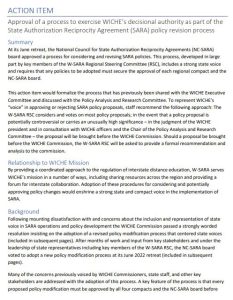
In June 2022, the NC-SARA Board adopted a revised process for making changes to SARA Policy -- the SARA Policy Modification Process. This process will go into effect starting in January 2023. This new process reflects the following guiding principles: transparency; collaboration; consistency; and clear and open communication among regional compacts, states, institutions, NC-SARA, and other stakeholders. The Regional Steering Committee and Regional Compact play a pivotal role in in the new policy modification process. Per Section 8.2 in the SARA Policy Manual, each Regional Compact is adopting and publishing a transparent process for their review (with their respective Regional Steering Committees) of proposed SARA Policy modifications. The W-SARA regional approach to policy proposal review can be found here.
Download PDF
Please send W-SARA inquiries to: wsara-info@wiche.edu.