×
Addressing Nursing Workforce Challenges in the West
Summary
This series of issue briefs explores how institutions and states are responding to critical nursing workforce challenges, particularly in recruiting and retaining nurse educators and clinical preceptors.
Roundtable participants identified several major nursing education challenges, including:
- Pay disparities between faculty and clinical roles
- Heavy workloads that impact job satisfaction
- Limited availability of clinical preceptors
- Challenges in developing a sustainable pipeline of prepared nurses
These factors contribute to broader challenges facing the nursing workforce in the United States, affecting the ability of colleges of nursing and healthcare systems to educate and retain the next generation of nurses. The briefs also highlight strategies being implemented at the institutional, state, and federal levels to strengthen the nursing workforce and support long-term workforce development.
Nursing Workforce Challenges
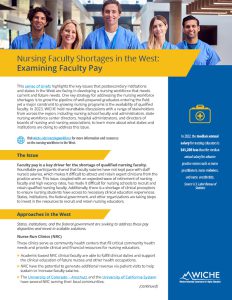
Examining Faculty Pay
August 24, 2023
The median annual salary of nurse educators is more than $40,000 less than the median salary of advanced practice nurses. This disparity presents a major nursing workforce challenge, impacting the recruitment and retention of qualified faculty within nursing programs. This brief examines how compensation gaps affect faculty supply and explores policy strategies to address nursing education challenges and strengthen the pipeline of prepared nurses.
Learn More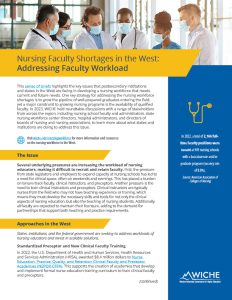
Addressing Faculty Workload
August 24, 2023
With vacancy rates approaching 9%, colleges of nursing are facing significant challenges facing the nursing workforce, particularly in retaining faculty. In addition to pay disparities, workload pressures play a major role in limiting job satisfaction and increasing turnover among nursing staff in academic settings. This brief highlights how institutions and policymakers are addressing workload challenges to improve retention and expand capacity across nursing programs.
Learn More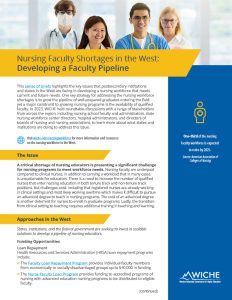
Developing a Nursing Pipeline
August 24, 2023
With one-third of the nursing faculty workforce projected to retire by 2025, institutions must address the growing demand for nursing while strengthening the pipeline of future educators and clinicians. This brief focuses on long-term strategies to address nursing shortages, expand educational opportunities, and ensure a steady supply of prepared nurses to meet future workforce needs.
Learn More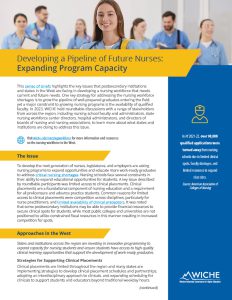
Expanding Capacity
September 13, 2023
Expanding the capacity of nursing programs is essential to addressing ongoing nursing workforce challenges. One of the most significant barriers identified by institutions is limited access to clinical placements for students across all levels of nursing education. This brief examines how constraints in clinical training limit enrollment and explores strategies being implemented by institutions, states, and the federal government to expand capacity and educate more prepared nurses.
Learn More
Nursing Student Access & Success
September 13, 2023
Students pursuing nursing degrees face structural and financial barriers that affect both access to and success in nursing education. These challenges are especially pronounced for students in rural communities and other underserved communities. This brief highlights strategies used by institutions and states to improve student outcomes, expand access to nursing programs, and support the development of the future nursing workforce.
Learn MoreResources for Addressing Nursing Workforce Challenges
This repository includes articles, reports, and examples of effective practices from across the West and the nation. These materials expand on key nursing workforce challenges, offering insights into nursing education challenges, workforce development strategies, and innovations across health systems and higher education. These resources support efforts to strengthen the nursing workforce, address nursing shortages, and improve outcomes for nursing staff, students, and communities.
Nursing Faculty and Preceptor Shortages
- Resource | American Association of Colleges of Nursing. (2022, October). Nursing Faculty Shortage Fact Sheet.
- Presentation | Massachusetts Action Coalition, Identifying and Describing Nursing Faculty Workload Issues: A Looming Faculty Shortage.
- Report| National Advisory Council on Nurse Education and Practice. (2021, January), Preparing Nurse Faculty, and Addressing the Shortage of Nurse Faculty and Clinical Preceptors, 17th Report to the Secretary of Health and Human Services and the U.S. Congress.
- Article | National Academies of Sciences, Engineering, and Medicine; National Academy of Medicine; Committee on the Future of Nursing 2020–2030; Flaubert JL, Le Menestrel S, Williams DR, et al., editors. (2021, May). The Future of Nursing 2020-2030: Charting a Path to Achieve Health Equity. Washington (DC): National Academies Press (US); 2021 May 11. 7, Educating Nurses for the Future.
- Article | Deatrick, J.A. and Given, B. (2011), Creating a pipeline for tomorrow’s nurse researchers. Res. Nurs. Health, 34: 171-175.
- Blog | Ferguson, S. (2018, May). Bolstering the Nursing Education Pipeline.
- Report | Oregon Longitudinal Data Collaborative (2023), Postsecondary Healthcare Education Shortage in Oregon.
Nurse Run Clinics
- Institution Example | University of Colorado College of Nursing owns and operates 4 nurse run clinics in 9 locations
- Institution Example | There are several nurse run community clinics across the University of California system
- Article | Jean Dowling Dols, Holly A. DiLeo, Diana Beckmann-Mendez, Nurse-Managed Health Centers: Financial Sustainability, Community Benefit, and Stakeholders, The Journal for Nurse Practitioners, Volume 17, Issue 6, 2021, Pages 712-717, ISSN 1555-4155, https://doi.org/10.1016/j.nurpra.2021.01.022.
- Resource | National Nurse-led Care Consortium. Nurse-Managed Health Clinics in Pennsylvania.
Faculty Practice Partnerships
Resource | American Association of Colleges of Nursing Practice Partnership Resources
- Article | Moss A, Rousseau J, Swartwout K, et al. (2022). Leveraging a successful faculty practice model to recruit and retain early-career nurse faculty. Nurse Educ. 2022;47(4):219-224. doi: 10.1097/NNE.0000000000001177.
- White Paper | The National Organization of Nurse Practitioner Faculties. (2016). Background Paper: Benefits of Faculty Practice Partnerships 2016.
- Article | Spector, N., Buck, M., Phipps, S. (2021, December). A New Framework for Practice-Academic Partnerships During the Pandemic – and Into the Future. Am J Nurs. 2021 Dec 1;121(12):39-44. doi: 10.1097/01.NAJ.0000803192.68710.8f.
State Investment into Nursing Expansion
Arizona
- In 2022, Arizona passed HB 2691 which established the Arizona Nurse Education Investment Pilot Program. The program seeks to increase the capacity of nurse education programs through funding for salaries and benefits to increase nursing faculty as well as investments into the expansion of nurse preceptor trainings.
Colorado
- Colorado offers a tax credit for preceptors serving in rural and healthcare shortage areas across healthcare fields, including registered nurses and advanced practice nurses.
Hawai‘i
- In 2022, Hawai’i invested $1.75 million for 39 faculty positions across the University of Hawaii system.
- Since 2018, Hawai‘i has provided a tax incentive to eligible healthcare providers who serve as preceptors for nursing students.
New Mexico
- In 2022, New Mexico awarded $15 million to expand nursing across the state, including enhancing faculty recruitment and retention through competitive salaries, stipends, and other compensation.
Washington
- Washington passed HB 2158 (2019) which provided $40 million to the state’s community and technical colleges to increase nursing faculty salaries and reflected an overall increase of 26.5% for these salaries.
- Washington passed HB 2007 (2022), which established a nurse educator loan repayment under the Washington Health Corps.
- The Washington State Student Nurse Preceptorship Grant provides financial benefits to clinical preceptors supporting nursing students in the state.
Faculty/Preceptor Trainings and Mentoring
- In 2022, the U.S. Department of Health and Human Services, Health Resources and Services Administration (HRSA), awarded $8.4 million dollars in Nurse Education, Practice, Quality, and Retention-Clinical Faculty and Preceptor Academies (NEPQR-CFPA). There three active academy grants in the West:
- Region 9: Western University, the Benner Institute, HealthImpact, and San Antonio Regional Hospital are collaborating to providing training to clinical educators to enhance their practice of teaching.
- Region 8: The Montana Office of Rural Health and Area Health Education Center, Colorado Center for Nursing Excellence, Schools of Nursing at the University of Colorado, Montana State University, North Dakota State University, South Dakota State University, University of Utah, and University of Wyoming have partnered to develop the clinical nursing faculty and preceptor academy to equip clinical faculty and preceptors working in rural areas.
- Region 10: Oregon Health & Science University is developing the Oregon Nursing Education Academy (ONEA) to increase the number of clinical nursing faculty and preceptors in HRSA region 10 (Oregon, Idaho, Washington, and Alaska).
- Example | The Washington Center for Nursing has a Diverse Nursing Faculty Mentorship Program to provide a 12-month mentorship program for new nurse educators from underrepresented backgrounds.
- Toolkit | National League fir Nursing (NLN). (2022, March). NLN Mentoring Toolkit.
- Article | Dunham-Taylor, J. & et al. (2008). What goes around comes around: Improving faculty through more effective mentoring. Journal of Professional Nursing, Vol 24, No 6 (November–December), 2008: pp 337–346. doi:10.1016/j.profnurs.2007.10.013.
- Blog | Terry, S. (2017, November). Mentorship program and novice nursing faculty.
Shared Curriculum Models
- State Example | The Oregon Consortium for Nursing Education is a collaboratively created consortium of 11 community colleges and six universities. The partners share common prerequisites and admission standards and supports transfer across the institutions.
- State Example | The New Mexico Nursing Education Consortium is a collaborative of state and tribal-funded nursing programs to support multiple pathways into nursing through a common pre-licensure RN curriculum.
- State Example | ReNEW is Wyoming’s shared nursing curriculum across the state’s community colleges and the University of Wyoming (UW) School of Nursing. The program allows for students enrolled in Associate Degree in Nursing (ADN) programs to simultaneously enroll in Bachelor’s of Science in Nursing (BSN) coursework at UW.
- State Example | The California Collaborative Model for Nursing Education is a collaborative model to increase access for more licensed RNs and allows for dual enrollment at ADN and BSN programs across partnering institutions.
- White Paper | Boller, J., & et al. (2008). White Paper: Nursing Education Redesign for California.
- Resource | Close, L. (2012, September). The Shared Curriculum Model.
Academic Practice Partnerships
- Institution Example | University of San Francisco and Kaiser Permanente academic-practice partnership
- Institution Example | University of Utah and Residential Juvenile Justice Services academic-practice partnership
- Institution Example | University of Hawaii and The Queen’s Health System academic-practice partnership
- Institution Example | Arizona State University and Mayo Clinic Arizona academic-practice partnership
- Resource | American Association of Colleges of Nursing. (2012). The Guiding Principles for Academic – Practice Partnerships.
- Video | Minnesota State HealthForce Center of Excellence, Academic-Practice Partnerships.
- Webinar | Preparing the next generation of practice-ready nurses
Centralized Clinical Placement Scheduling
- State Example | Hawai’i uses a centralized scheduling system
- State Example | California uses a centralized clinical placement system
- State Example | The Arizona Clinical Education Consortium (AzCEC) is a community resource to support the complex scheduling demands of students participating in clinical education experiences in Maricopa County.
Dedicated Education Units
- Institution Example | The University of Portland pioneered this model in the early 2000s and currently offers DEU in areas of community health, acute care, post-acute care, school-based nursing, ambulatory care, and mental health settings. Research on the University of Portland model found students viewed DEU as a high-quality learning environment with advantages over a traditional clinical setting.
- Institution Example | A review of the University of Nevada Las Vegas School of Nursing Dedicated Education Unit found positive outcomes for students and staff in the first five years of the community partnership.
- Institution Example | Boise State University has worked in partnership with St. Luke’s Hospital to redesign its collaborative DEU model to support students and will add an additional focus on measuring the effectiveness of DEU.
Resource | American Nurses Association (2015). Dedicated Education Units: An Innovative Model for Clinical Education.
Nurse Apprenticeship Programs
- State Example | Utah developed a nurse apprenticeship license to help support the nursing workforce during the COVID-19 pandemic. This apprenticeship licensure became permanent through the passage of SB 101 during the 2022 legislative session.
- State Example | Nevada’s Nurse Apprentice Program is eligible to pre-licensure Practical Nurse (PN) and RN students and provides students the opportunity to earn valuable on-the-job training while receiving financial compensation.
- State Example | Colorado’s CO-HELPS Healthcare Apprenticeship Program is intended to help develop the state’s healthcare workforce through apprenticeships in entry-level positions and supports a student’s ability to enter a pathway to a registered nursing position.
- State Example | Wyoming has a statewide Certified Nursing Assistant apprenticeship program.
- State Example | HealthCARE (Creating Access to Rural Education) Montana is a collaborative project to recruit and retain healthcare professionals in rural Montana, including the development of apprenticeships.
Supporting Rural & Underserved Communities
- Institution Partnership Example | The University of Colorado Anschutz Medical Center’s College of Nursing and Fort Lewis College forged a partnership to develop the CU Nursing Fort Lewis College Collaborative. This collaborative model brings together the two postsecondary institutions to develop a four-year nursing degree to Fort Lewis College in southwest Colorado that is focused on providing a nursing curriculum aligned to rural, Indigenous healthcare perspectives.
- Institution Example | Montana State University’s Caring for Our Own Program is a student support program for American Indian/Alaska Native nursing students. The program provides supplemental support for MSU students through culturally competent advising, access to a network of American Indian/Alaska Native nursing students and nurses, and resume and job search support.
- State Example | The New Mexico Nursing Education Consortium is a statewide prelicensure nursing curriculum that offers Bachelors of Science in Nursing (BSN) programs across the state and includes community college and university partnerships to offer dual enrolled Associate Degree in Nursing (ADN) and BSN degree pathways. This collaboration expands educational opportunities across all regions of the state and supports the development of the rural healthcare workforce in New Mexico.
- Institution Example | Montana State University Mobile Clinics provide nursing students with training and experience working in high-need rural communities and support students through clinical travel reimbursements and participation in rural health-focused elective courses.
Interprofessional Education
- Institution Example | University of San Francisco’s Program for Interprofessional Practice and Education
- Institutional Example | University of Utah’s Interprofessional Education Program (IPE)
- Institutional Partnership Example | Arizona State University, Northern Arizona University, and the University of Arizona collaboratively developed the Student Health Outreach for Wellness (SHOW), a student run clinic serving homeless populations in the Phoenix area. The model is being expanded to serve adults with substance abuse disorders.