×
Challenges and Opportunities for Supporting Nursing Students and Rural Communities
Summary
In the summer of 2025, WICHE convened stakeholders from Colorado, New Mexico, and Wyoming to examine challenges and opportunities in rural nursing policy and workforce development. Participants included leaders from nursing schools, healthcare providers, and state agencies working across health systems in the region. The discussion emphasized that rural nursing plays a critical role in delivering primary care and sustaining health care access in underserved communities in the West. The rural nursing workforce faces complex, interconnected challenges stemming from workforce shortages, limited educational opportunities, and broader constraints within rural health systems.
The convening reinforced the need to strengthen the nursing workforce in rural areas through coordinated action across education, workforce policy, and healthcare delivery systems.
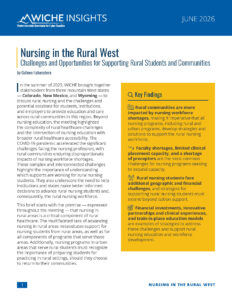
WICHE Insights: Nursing in the Rural West
June 11, 2026
This policy brief explores the need to strengthen rural nursing and the rural nursing workforce across Western states. It examines barriers to rural nursing education, workforce capacity, and access to care, while highlighting actionable strategies to improve outcomes in rural healthcare systems.
Learn MoreKey Findings on Rural Nursing Workforce and Education
Rural Communities
Rural communities are more impacted by nursing workforce shortages, making it imperative that all nursing programs, including rural and urban programs, develop strategies and solutions to support the rural nursing workforce.
Faculty Shortages
Faculty shortages, limited clinical placement capacity, and a shortage of preceptors are the most common challenges for nursing programs seeking to expand capacity.
Financial Challenges
Rural nursing students face additional geographic and financial challenges, and strategies for supporting rural nursing students must extend beyond tuition support.
Investments and Partnerships
Financial investments, innovative partnerships, clinical experiences, and train-in-place education models are examples of strategies to address these challenges and support rural nursing education and workforce development.
Key Challenges in the Rural Nursing Workforce Pipeline
Workforce and Education Capacity Constraints
A major barrier to expanding the rural nursing workforce is limited capacity within nursing programs. Faculty shortages, lack of clinical placements, and limited preceptor availability restrict the number of students who can be trained.
Barriers to Accessing Nursing Education
Students in rural areas face significant challenges in accessing nursing education, including long travel distances, limited access to educational opportunities, and high out-of-pocket costs. These barriers reduce access to nursing education in rural America and limit the pipeline of future nurses.
System-Level Healthcare Constraints
Challenges within health systems also impact workforce development. Rural hospitals and providers often face staffing shortages, limited services, and financial constraints, making it difficult to support training and clinical placements for students.
Student Challenges
Students pursuing rural nursing education often face geographic isolation, financial strain, and limited flexibility due to the demands of clinical training. These barriers can make it difficult to complete nursing degrees, particularly for students who want to remain in their home communities.
Strategies and Opportunities
Expanding Train-in-Place Education Programs
“Train-in-place” models allow students to complete their education program within their local communities, reducing travel and increasing retention in rural communities.
Examples from the region show how partnerships between institutions can expand access to nursing programs while allowing students to remain in rural areas.
Earn-and-Learn Pathways
Earn-and-learn models, including apprenticeships, provide students with opportunities to gain experience as a registered nurse while earning income. These models also strengthen workforce retention, as students are more likely to remain in the rural communities where they train.
Financial Supports
Expanding financial aid beyond tuition is essential. Students in rural nursing education programs often need support for housing, transportation, and childcare. Targeted investments can improve access to nursing degrees and support long-term workforce growth.
Expanding Clinical Placements Across Rural Health Systems
Limited clinical placements remain one of the biggest barriers to expanding the nursing workforce. In rural healthcare settings, fewer facilities and patient volumes can make it difficult to meet training requirements. Students may also need to travel long distances, adding cost and complexity.
Innovative Clinical Partnerships
Partnerships with nontraditional providers, such as community health organizations and alternative care sites, can expand opportunities for clinical training within rural health systems.
Coordinated Clinical Systems
Improving coordination across health systems can reduce administrative burdens and improve access to placements for students in nursing programs.
Academic–Practice Partnerships
Collaboration between education providers and healthcare organizations strengthens training pathways and supports workforce retention, particularly in primary care roles and nurse practitioner pathways.
Dedicated Education Units (DEUs)
DEUs create structured partnerships between nursing schools and healthcare providers to improve clinical training experiences while supporting workforce development in rural communities.
Building a Stronger Rural Nursing Workforce
Strengthening the rural nursing workforce is essential to ensuring access to care in underserved communities and sustaining rural healthcare systems. By expanding access to nursing education, supporting students, and investing in workforce infrastructure, states can build a more resilient and responsive nursing workforce.
Efforts to improve rural nursing will not only benefit rural communities, but will also strengthen broader health systems across the region.
Sponsor

WICHE is a member of the National Rural Higher Education Research Center led by MDRC. The research reported here was supported by the Institute of Education Sciences, U.S. Department of Education, through Grant R305C240065 to MDRC. The opinions expressed are those of the authors and do not represent the views of the Institute or the U.S. Department of Education.